by Lana Jacobus and Katie Kristensen
About the Initiative
Enterprise Community Partners launched the Thome Aging Well program in 2022. Funded by the Edward N. and Della L. Thome Memorial Foundation, Bank of America trustee, this four-year, $19 million program supports organizations committed to helping older adults living in Maryland and Michigan age safely and securely at home and in their communities.
Under this umbrella of work, the Scale What’s Working program provides grant funding to scale work that improves the health and well-being of older adults with lower incomes.
In addition to receiving funding, each Scale What’s Working grantee participated in a multi-year learning collaborative with other grantees, received technical assistance from a third-party evaluation firm and had the opportunity to network with funders in the field.
A large conference room began to buzz with energy as attendees convened for Enterprise Community Partners’ event, Celebrating the Thome Aging Well Program’s Scale What’s Working Grantees. The occasion brought over 70 grantees, partners, and funders together for a celebration of their ongoing efforts and learning exchange. Among them was Katie Kristensen, Manager of Equitable Evaluation for Success Measures, who was present to share evaluative learning from the program.
In 2024, Success Measures was selected to provide Enterprise with insights and analysis about key aspects of the Thome Scaling What Works grantee experience. Enterprise sought to understand grantees’ experiences in serving older adults. This included understanding how grantees were scaling facilitators, strategies they implemented along the way, and existing programs or barriers hindering scaling.
Since most of the evaluation took place remotely, September’s gathering offered an opportunity to contextualize what was happening on the ground with the evaluation’s observations, as well as make in-person connections among grantees, partners, and the Enterprise team.
The time together strengthened both relationships and understanding for everyone involved. Attendees, representing two grantee cohorts, made the most of the chance to gather and connect with their peers. They reviewed their accomplishments, discussed ideas for the current funding environment, heard from panels of their peers and collaborated in small group discussions. Katie was thrilled to meet grantees in person and gain new insights into their work and their approaches.
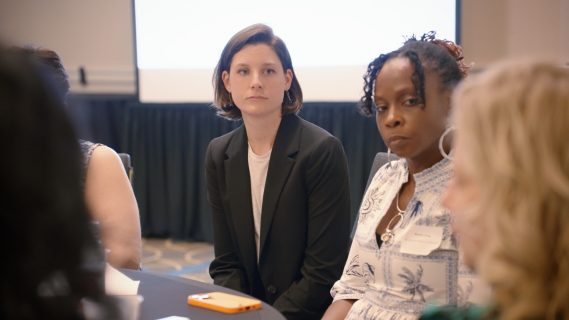
Katie listening to a table of grantees, including Kristie King, representing the Jewish Family Services, a Thome grantee.
Katie’s presentation followed the grantee panel and shared the themes that emerged from the evaluation. While unplanned, the overarching themes echoed the individual experiences grantees had shared, helping the full cohort understand the connections within their collective Thome Aging Well program experience.
From creative staffing models to new approaches in community engagement, these grantees are not only expanding their reach but rethinking how their organizations operate and grow. Sourced from the evaluation findings and brought to life by grantee presentations, we heard that:
- Scaling starts with structure: Many grantees shared that scaling starts with building internal capacity. That means hiring the right people, navigating organizational shifts and having the flexibility to get systems in place before programs take off. For grantees, scaling often followed internal improvements, like better collaboration across departments, stronger policies or internal systems and building a shared mind-set for testing new ideas and learning as you go.
- Scaling looks different for everyone: Nobody identified a one-size-fits-all solution to scaling their programs. Instead, common principles for scaling their work emerged, such as keeping it people-centered and context-dependent. Grantees scaled by expanding their reach, testing new models, deepening community engagement and building partnerships.
- Sustaining the work is a shared priority: While scaling their work was an enormous success, sustaining these efforts remains a major focus. Some have already woven into program elements into ongoing operations, but others are still seeking the resources to continue. Organizations shared the strategies they are using to prepare for life after the grant: developing sustainability plans early, exploring alternative staffing models and using the success of their Thome-funded work to attract added support.
Being together that day was just one of many important acts it takes to build trust. Underpinning all these insights was Enterprise’s trust-based philanthropy approach. The trust-based design of the Thome Aging Well grant created the conditions grantees needed to truly scale what worked. The two-year funding period provided predictability, strengthened staffing, enabled thoughtful expansion and gave organizations the freedom to test new ideas. Flexible funding supported grantees while meeting emerging needs.
Katie summed it up when she reflected on the day, “Being curious together, witnessing each other’s experiences, having dialogue about what’s working and what’s not. That is the role evaluation can play in building trust. Gathering at this event to do just that is one of the many acts that build relationships needed for trust-based philanthropy to work.
Acknowledgments
Success Measures has been working with Enterprise Community Partners since 2018 across multiple Enterprise projects and departments. We are grateful for their long-term partnership and collaborations.
Enterprise Community Development:
Stephany De Scisciolo (Vice President of Impact, Evaluation and Population Health)
Evaluation Team:
Success Measures staff, Jessica Anders-Mulcahy (Evaluation Director) and Katie Kristensen (Lead Evaluator), along with our consulting partner Karen Horsch Consulting LLC