
by Lana Jacobus and Katie Kristensen
NCHE is a nonprofit organization that aims to promote racial and health equity by supporting community leaders, harnessing data, and catalyzing partnerships across sectors to create a more equitable and just society. CoHLI, an 18-month leadership institute opportunity, is a core piece of their work that is grounded in the Truth, Racial Healing, and Transformation (TRHT) framework.
TRHT encompasses a community-based framework for action that aims to bring about transformational change through racial healing. CoHLI builds a unique community where leaders from across multiple health and racial equity-related fields have an opportunity to explore personal and collective healing through collaborative learning experiences and resource sharing, with the understanding that without racial healing and relationship building, changes in policies and practices are short-lived.
In 2022, the nonprofit organization National Collaborative for Health Equity (NCHE) welcomed its first cohort of 40 leaders into its Culture of Health Leadership Institute for Racial Healing (CoHLI). From the beginning, NCHE recognized it was a story that needed to be told.
While evaluation was already embedded into the design of the Institute, NCHE wanted to capture the story of the program and its leaders. They sought an evaluation partner experienced in assessing initiatives grounded in human experience and communicating impact through the lens of leaders’ lived realities. Success Measures met this need by designing a learning process rooted in shared values, reflection, and storytelling.
The Evaluation
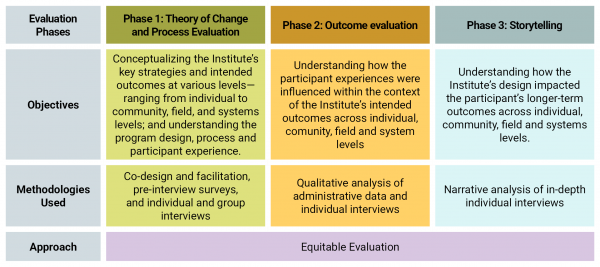
Over three years, Success Measures led a multi-phase evaluation and learning process. Phase one focused on co-developing a theory of change and conducting a process evaluation to understand the CoHLI design, delivery, and participant experience. Phase two carried out an outcome evaluation to assess the Institute’s impact on leaders personally, as well as its broader influence on their communities and the field. Phase three, conducted using a storytelling approach, provided a deeper exploration into the intermediate or longer-term outcomes which bridged findings across the phase one and two of evaluation and provided additional context to any connections between the Institute’s design, participant experiences, and their engagement with communities and broader work in the field.
A Partnership Rooted in Shared Values
When NCHE sought an evaluation partner for CoHLI, they knew they needed a partner that could understand and embody the program’s values of being human centered, relational, and collective learning.
“It was about working with a team of individuals and experts that could embody the participatory, collective approach to evaluation. That was, and still is, a core value of CoHLI.” – Ina Robinson, NCHE’s Program Director
Success Measures’ ability to design the evaluation to center these values supported a genuine learning partnership, one that affirmed NCHE’s commitment to TRHT and helped them strengthen their approach to CoHLI. Building relationships was a focus of the evaluation team, both with NCHE and COHLI leaders themselves. To achieve this both Success Measures and the NCHE team came to the table with trust, open communication, and collaboration. This can be seen in the co-design of evaluation questions, the regular and consistent meetings and participation in CoHLI staff meetings, and by centering people in the design of all evaluation materials and tools.
“You (Success Measures) were just very curious throughout the process about what our priorities were and what our approach was to CoHLI and the collaboration always felt personal… It felt like there was so much synergy, and you really understood the heart of our work.” – Christina Johnson, NCHE Program Associate
Storytelling as Data
In the third phase, the evaluation turned to storytelling, a method that quickly emerged as one of its most meaningful elements. Leaders recounted moments when the program influenced how they lead, collaborate, and understand themselves. These stories revealed outcomes that were deeply intimate, like increased confidence or a reclaimed sense of belonging, as well as broader impacts, such as stronger network connections and more use of the TRHT framework within their organizations and communities.
“What’s often been hard to put into words, but I think it came out beautifully during the storytelling approach to the evaluation, is the deep connections that the leaders develop among and across cohorts. We have often heard leaders use terms like family when reflecting on their experience in the Institute.” – Ina Robinson, NCHE’s Program Director
In aggregate, these stories went beyond individual experiences. Collectively, they painted a picture of how CoHLI’s healing-centered model helped leaders reconnect with purpose, build cross-sector alliances, and prioritize crucial space for the continued need for rest and healing while implementing change.
Learning that Supports the Mission
The evaluation confirmed that CoHLI’s approach built on care, community, and reflection, and it was effective. Leaders consistently described the Institute as transformative, healing, and family-like. For NCHE, the evaluation served as a mirror, reflecting back the depth of CoHLI’s impact and validating the Institute’s intentional design.
“It felt so human-centered, and actually seeing the impacts it had in people’s lives made it feel very real. It also made it easier to share that impact with others.” – Christina Johnson, NCHE Program Associate
“The evaluation gave us additional language to communicate the impact of CoHLI back to partners, collaborators and funders.” – Ina Robinson, NCHE’s Program Director
The evaluation did not just affirm CoHLI’s success; it also led to concrete improvements. Insights from the evaluation prompted a shifting of the Institute elements to better support CoHLI’s mission. For example, leaders shared that they desired more collaborative time with one another as they matriculated through the various learning phases of the Institute experience. In response, the team adjusted the structure of the monthly virtual gatherings, extending the amount of time for shared learning and connection during gatherings. These changes strengthened CoHLI’s core commitment to creating a leader-led experience and ensured leaders had the space and resources they needed to exchange new ideas and share strategies as they supported one another in co-creating vision statements to guide their collective, actionable work in the field, addressing a diversity of conditions to reduce the negative impacts of racial and health inequities.
Carrying it Forward
Looking ahead, NCHE will continue embedding storytelling across its program areas strengthened by several resources developed in partnership with Success Measures. NCHE is exploring opportunities to continue the impactful model of the CoHLI experience and expanding its growing movement of national TRHT leaders on the ground. To learn more about NCHE and their work, visit www.nationalcollaborative.org.
Acknowledgments
Thank you to the incredible constellation of people who supported, informed, and facilitated this work. Special thanks to the Robert Wood Johnson Foundation for its funding and support of the CoHLI experience. We also recognize Dr. Gail C. Christopher, NCHE Executive Director, for her overall vision and guidance of the Institute. We are also grateful to the CoHLI leaders who shared their thoughtful insights during the evaluation.
National Collaborative for Health Equity (NCHE):
Dr. Ina Robinson (Program Director), Christina Johnson (Program Associate), and the entire NCHE team.
Evaluation Team:
Success Measures staff, Jessica Anders-Mulcahy (Evaluation Director) and Katie Kristensen (Lead Evaluator), along with our consulting partners at Datashine.